Where Did This Data Come From?
Making use of stack traces in TypeScript with Bun.
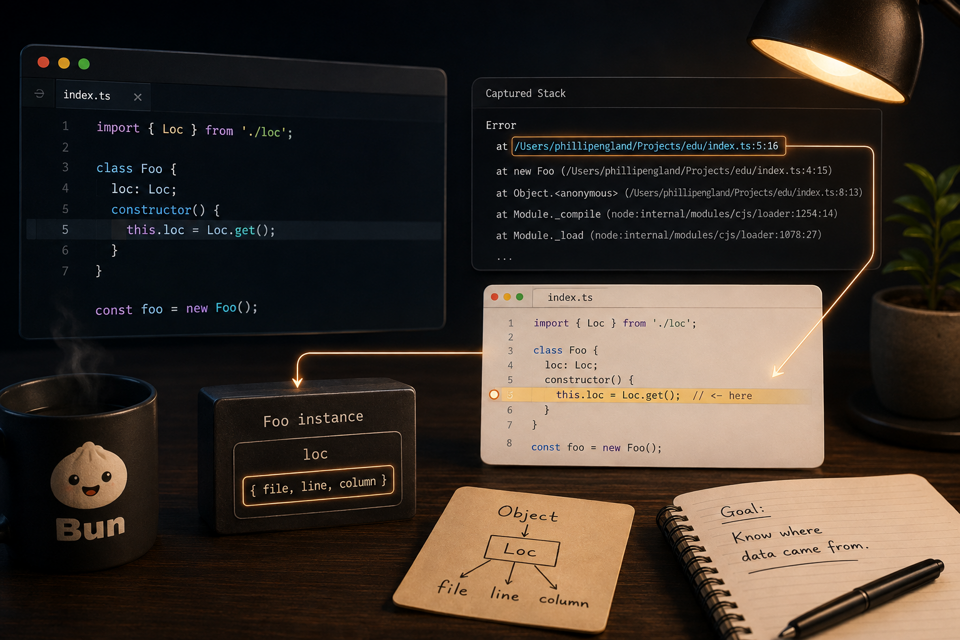
Where Did This Object Come From?
When building systems, it is important to know the origin of the data you are dealing with. In Bun, we have direct access to the stack trace. For example:
let t: { stack?: string } = {};
Error.captureStackTrace(t, undefined);
console.log(t);
This will produce something like:
{
  originalLine: 2,
  originalColumn: 24,
  stack: "Error\n    at /Users/phillipengland/Projects/edu/index.ts:3:7",
}
But, take note, we are using Error.captureStackTrace(t, undefined);. What happens if we do not use undefined?
...I had to go do a bit of research to figure this one out, let me walk you through what I found.
What is Currently on the Stack?
At first, I ended up with something like this:
function exampleOne() {
    function foo() {
        console.log('ahhh!');
    }

    foo();

    let t: { stack?: string } = {};
    Error.captureStackTrace(t);
    console.log(t.stack);
}

exampleOne();
Which produces the following output on my system:
ahhh!
Error
    at exampleOne (/Users/phillipengland/Projects/edu/index.ts:17:11)
    at /Users/phillipengland/Projects/edu/index.ts:21
Here is sort of how I verbalize this to myself:
# foo prints this
ahhh!

# we make a call to the static method 'captureStackTrace' on type 'Error'
Error
    # 'captureStackTrace' was called at this location while 'exampleOne' was running
    at exampleOne (/Users/phillipengland/Projects/edu/index.ts:17:11)

    # this is the location where 'exampleOne' was called
    at /Users/phillipengland/Projects/edu/index.ts:21
One thing I observe is that we do gain access to the location of Error.captureStackTrace(t), but the stack frame is associated with the function currently executing, which in this case is exampleOne. We also get the rest of the stack leading up to that call. This might not be ideal, let's take a look at another example.
Capturing the Exact Location of Error.captureStackTrace
Consider the following example:
function exampleTwo(t: { stack?: string }) {
    console.log(t.stack);
}

let t: { stack?: string } = {};
Error.captureStackTrace(t);
exampleTwo(t);
It produces the following output on my system:
Error
    at /Users/phillipengland/Projects/edu/index.ts:18:7
In this case, I observe we gain access to the direct location where Error.captureStackTrace(t) was called.
Likewise, if we continue to pipe the captured stack downward, it preserves its location:
function foo(t: { stack?: string }) {
    console.log(t.stack);
}

function exampleThree(t: { stack?: string }) {
    foo(t);
}

let t: { stack?: string } = {};
Error.captureStackTrace(t);
exampleThree(t);
Creating a Function to Capture Location
What if we wanted a function which allowed us to capture the current location? That would be a useful primitive in many different applications.
Here is what I came up with at first:
function exampleFour(): { stack?: string } {
    let t: { stack?: string } = {};
    Error.captureStackTrace(t);
    return t;
}

let loc = exampleFour();
console.log(loc.stack);
Which produces the following output on my system:
Error
    at exampleFour (/Users/phillipengland/Projects/edu/index.ts:13:11)
    at /Users/phillipengland/Projects/edu/index.ts:17:11
But, notice how this is cluttered and contains more than just the location I intend to grab? Well, Error.captureStackTrace provides a solution.
The second argument allows us to tell captureStackTrace which function should be omitted from the resulting stack trace, along with the frames above it. We can modify the function like so:
function exampleFive(): { stack?: string } {
    let t: { stack?: string } = {};
    Error.captureStackTrace(t, exampleFive);
    return t;
}

let loc = exampleFive();
console.log(loc.stack);
Which produces:
Error
    at /Users/phillipengland/Projects/edu/index.ts:16:11
Now the exampleFive frame itself is gone, leaving us with the location where exampleFive was called.
This provides a very clear path to creating a class dedicated to capturing the precise location of an object's initialization.
Putting it All Together
Using these concepts, I eventually ended up with something like this:
class Loc {
  constructor(
    public readonly file: string,
    public readonly line: number,
    public readonly column: number,
  ) {}

  static get(): Loc | null {
    const target: { stack?: string } = {};

    Error.captureStackTrace(target, Loc.get);

    if (!target.stack) return null;

    return Loc.parse(target.stack);
  }

  private static parse(stack: string): Loc | null {
    for (const line of stack.split("\n")) {
      const match = line
        .trim()
        .match(/^at (?:.+ \()?(.+):(\d+):(\d+)\)?$/);

      if (!match) continue;

      return new Loc(
        match[1] as string,
        Number(match[2]),
        Number(match[3]),
      );
    }

    return null;
  }
}

console.log(Loc.get());
Which produced the following on my system:
Loc {
  file: "/Users/phillipengland/Projects/edu/index.ts",
  line: 46,
  column: 17,
}
Which is exactly what we want. A simple primitive in Bun which can be composed into other objects to determine their place of origin within a given program, like so:
class Foo {
    loc: Loc | null;

    constructor(loc: Loc | null) {
        this.loc = loc;
    }
}

let foo = new Foo(Loc.get());
Now foo.loc points us back to the location where Loc.get() was called, giving the object a simple way to carry information about where it originated.